Agent · 01
Prescription Reader
Handwritten and printed scripts into structured, verifiable medication records — low-confidence fields flagged for human review, tuned to local formularies and abbreviations.
Disha is a sealed clinical-AI appliance that sees, hears and speaks. Its agents read what the ward produces — prescriptions, case sheets, bedside monitors, HIS records — draft final documents, surface the clinical picture, and hand everything to your clinicians to validate. No cloud. No new logins. No data ever leaves the room.
Happy providers make happy patients.
Care is DUST(y) — and two decades of digitisation added logins, forms and click-paths without taking the tedium away. Disha automates the data entry that bottlenecks clinical operations, so the EHR you already own finally gets adopted — and your clinicians get room to be human in the difficult, uncertain, scary parts.
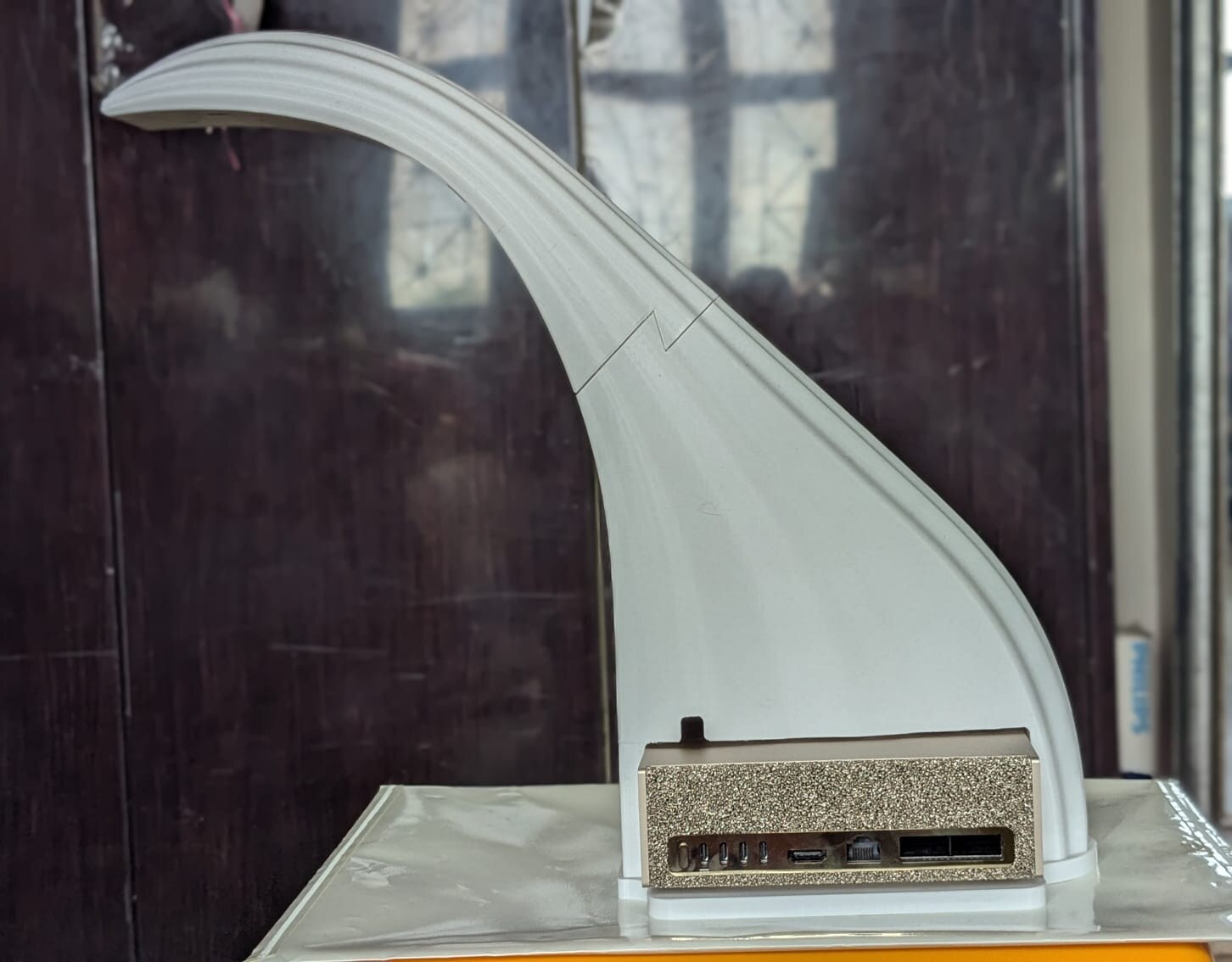
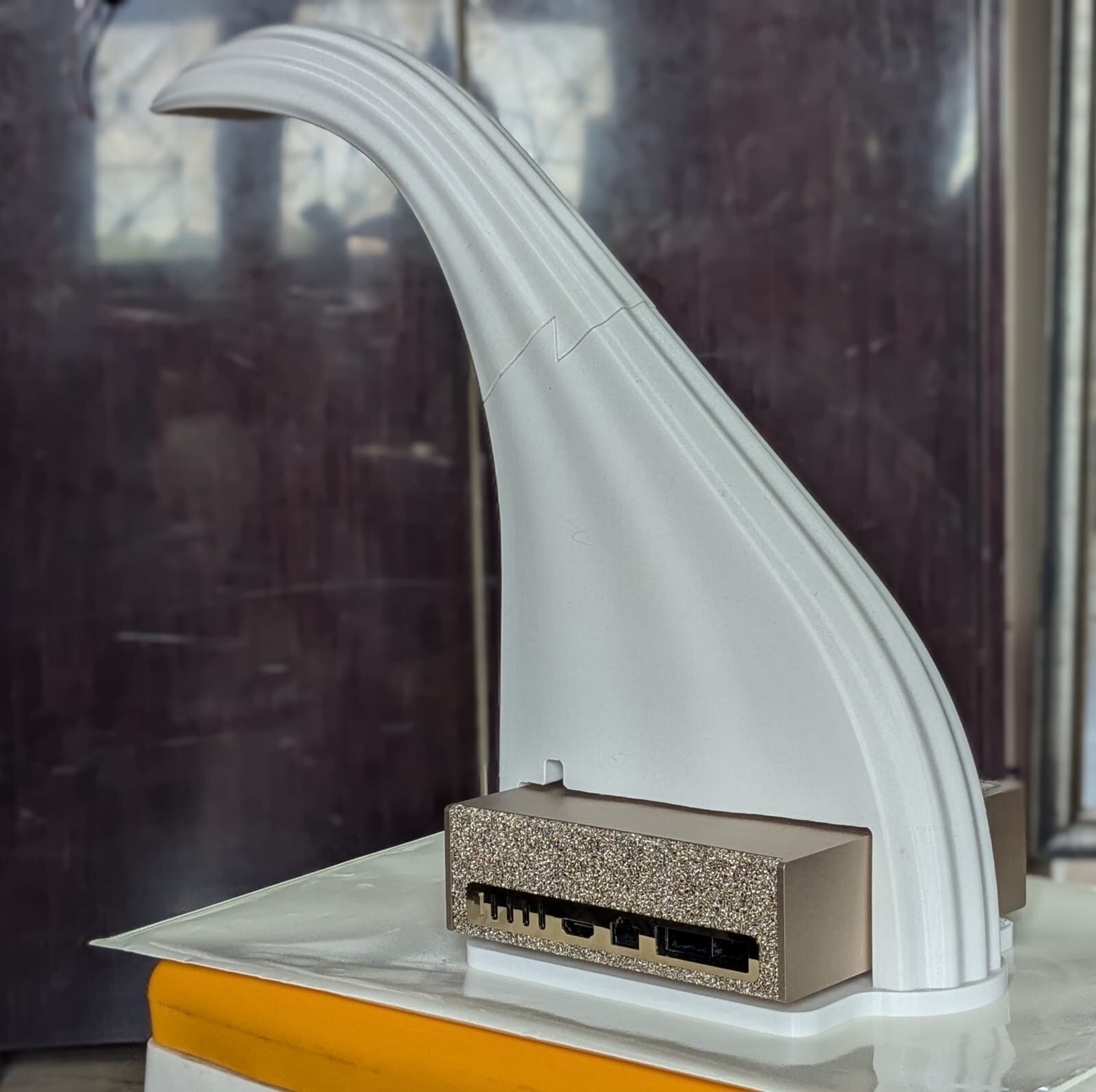
A sealed clinical-intelligence appliance with minimal infrastructure demands — plug & play. Agents arrive preinstalled — no additional infrastructure required — and it sits beside your HIS/EMR, not in place of it.
Every model runs on the box. Raw inputs never leave the device — data residency is a property of the hardware, and ownership rests with your institution.
Fully offline operation at every stage — privacy-preserving and designed for compliance by construction.
Agents learn your workflows; your staff never learn new software.
Inputs: paper documents, bedside monitors, room audio and HIS records. Outputs: consultant-ready draft documents and structured clinical reads — every output validated and signed by your clinicians. The HIS is a source as well as a destination: RoR reads investigations back into trends and a provisional read.
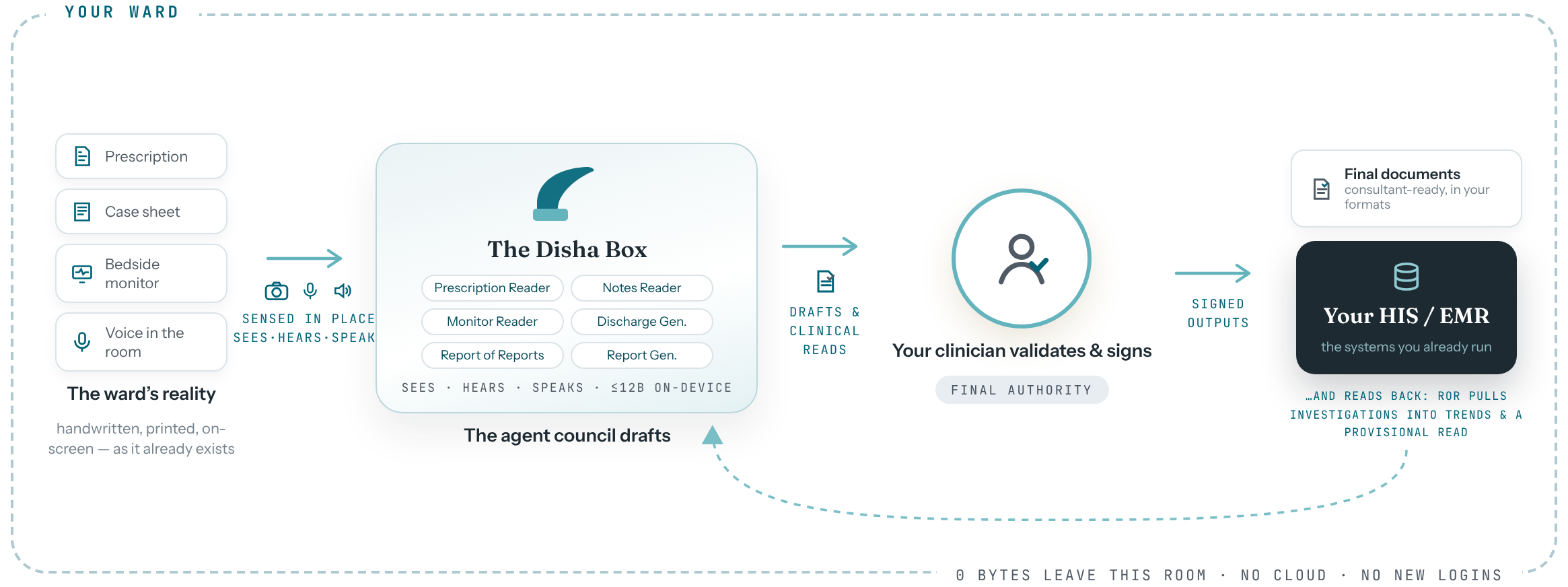
Interoperable, domain-limited, and immersed in your existing workflows — from Prescription Readers to Discharge Summary Generators, deploy the intelligence your hospital needs, on-site.
Handwritten and printed scripts into structured, verifiable medication records — low-confidence fields flagged for human review, tuned to local formularies and abbreviations.
Case sheets, progress notes and mixed-format documents into structured summaries the care team can act on.
Vitals straight from photographs of bedside monitors and instruments — one nursing round, complete structured chart, no re-typing.
Clinical and operational reports assembled from agent outputs, with transparent sourcing back to the underlying documents.
Consultant-ready discharge summaries from the full case sheet — clinically deployed at a 200-bed multi-specialty hospital in Chennai, with published endpoints.
Investigations from HIMS/LIS into trends, abnormal summaries, hospital-format charts and a grounded provisional diagnosis.
+ Radiology Explainer · Trial Organizer · Data Harmonizer · De-identifier · voice productivity agents — the full catalogue lives in the agent showcase.
Domain-limited, real-world problems with low-friction, measurable scope.
Background by default, surfacing when needed. The clinician always sees why an output says what it says.
Every agent declares intent and reveals action. Human validation remains the final authority.
Two hospitals in, measured before we scale — a 200-bed multi-specialty hospital in Chennai and a working hospital in Kolkata. Documentation was the first measured endpoint; the same on-box loop powers all six agents. Disha is deliberately evidence-driven: deploy against the manual workflow, measure clinical endpoints, publish the result, and let you inspect it before you buy.
Endpoint-style measurement of capture, processing, validation and generation quality at a 200-bed multi-specialty hospital — ~14 minutes end-to-end on a 25-page case sheet.
Full endpoint report — available on requestInvestigations pulled from HIMS/LIS and turned into trends, abnormal summaries, hospital-format charts and a grounded provisional diagnosis.
Full trial report — available on requestThirteen stakeholders, two facilities, 201 artifacts catalogued — closing with an HDU-floor pilot authorized by hospital leadership.
Read the field immersion report →A pipeline shaped by the field: Prescription Reader hardening, voice capture for OP consults, handwriting OCR, insurance workflow assistance — and engagements in discussion, e.g. a behavioral-health edition of the box with a regional wellbeing group, drafting session documentation in the language of the room. In discussion — not yet deployed.
Modelled on Disha’s published pilot measurements for discharge documentation. Move the slider to your hospital’s planned daily discharges. Discharge is simply the first endpoint we’ve published — one agent of six.
Disha is being built for the evolving regulatory landscapes of South-East Asia — NABH (India), GDAC (Cambodia), and the frameworks of Singapore and Malaysia — with the documentation completeness, consistency and audit trails that earning and keeping your hospital’s accreditation demands.
It is engineered to comply with regional health-data protection standards: every model runs on the box, so data residency is a property of the hardware, not a promise in a contract. And because every output is reviewed and signed by your clinicians, Disha works today as a clinician-assist layer — human validation is the final authority.
Three deployment models, one sales ladder — and every step measured before you take the next one.
Per-bed on the ward — the discharge desk, the nursing station, the ICCU corner. The smallest footprint with the fastest payback.
A per-department workbench — radiology, pathology, the OPD — with the agents that department actually needs.
The whole-clinic bundle for smaller facilities — one box, all six agents, everything on-site.
Every deployment can begin as a measured Dishari pilot — the agent runs against your manual workflow, clinical endpoints are recorded, and the findings report is yours to keep and inspect before you scale. It’s how every number on this page was earned.
Disha is the clinical-intelligence product of the SBX Group — the digital-biology company spun off in 2011 from the Systems Biology Institute, Tokyo, the non-profit that helped create the field of systems biology itself. Bootstrapped, profitable and stable for over a decade, and powered by the Garuda agent framework.

CEO, SBX Corporation · President, Systems Biology Institute Tokyo · CTO Fellow, Sony Group

COO, SBX Corporation · CEO, SBX Technologies · PhD CS, University of Texas

VP, SBX Corporation · CTO, SBX Technologies · PhD CS, National University of Singapore
A ward demo takes one desk, one afternoon, and none of your patient data. If it earns its place, start a measured pilot — the endpoints are recorded, and the findings report is yours either way.